
The Complete Guide to Understanding Corporate Credit Risk
How to analyze bankruptcy risk, default probability, and credit events - from institutional methods to practical applications
Introduction
In December 2025, CoreWeave's credit default swap spreads blew out to 700 basis points. For anyone monitoring credit markets, this was a screaming signal: the institutional credit market was pricing serious default risk into a company that had just gone public nine months earlier. Meanwhile, IREN Limited showed the opposite pattern - a Z-Score of 7.84 signaling low credit risk despite a 38% stock decline, illustrating how credit risk and equity risk diverge.
Many watched these developments and wanted to understand what they meant. They could see CDS spreads at 700bp, but what did that actually signal about bankruptcy risk? How do you interpret credit signals when they're this elevated?
This is the gap this guide addresses.
The institutional credit market is one of the largest, most liquid markets in the world. The credit default swap market alone represents trillions in notional value. Corporate bonds outstanding exceed $10 trillion in the US alone. Every major company's survival probability is continuously priced by sophisticated investors.
Yet understanding and monitoring these signals requires specialized knowledge.
This guide will teach you:
- How credit risk actually works and how to read the signals
- What tools institutions use to assess bankruptcy probability
- Why traditional approaches have limitations
- How to analyze credit situations and monitor them effectively
- How modern tools provide better visibility into credit events
By the end, you'll understand credit markets better than 95% of financial professionals, and you'll know how to monitor credit risk systematically.
Part 1: Credit Risk Fundamentals
What Is Credit Risk, Really?
Credit risk is simple: it's the risk that someone who owes you money won't pay you back.
When you buy a corporate bond, you're lending money to a company. They promise to pay you interest and return your principal. Credit risk is the chance they break that promise.
But credit risk isn't binary (until it is). A company doesn't go from "perfectly healthy" to "bankrupt" overnight. There's a spectrum of creditworthiness, and companies move along that spectrum based on their financial health, industry conditions, and market sentiment.
The key insight: Credit risk is priced continuously. At any moment, the market has an opinion on how likely a company is to default, and that opinion is expressed in prices you can observe.
The Credit Spectrum
Companies exist on a spectrum from "risk-free" to "already defaulted."
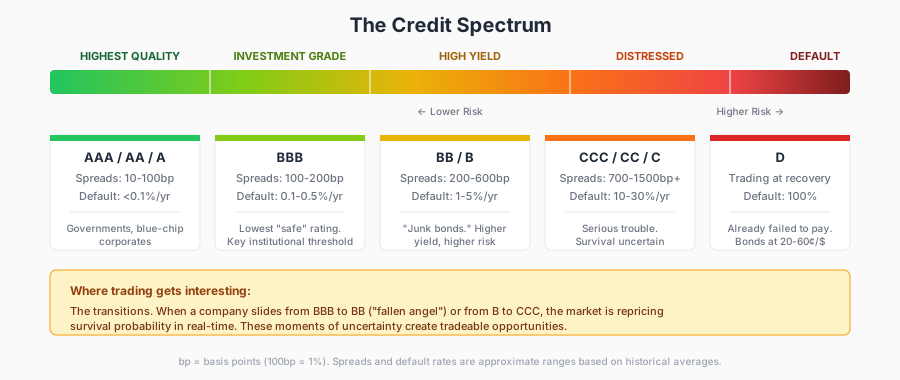
Investment Grade (AAA to BBB): These companies have strong balance sheets and reliable cash flows. They can borrow cheaply because lenders trust them. Default is rare, typically less than 0.5% annually even for BBB-rated companies.
High Yield / "Junk" (BB to B): These companies have weaker credit profiles. Maybe they're highly leveraged, in a cyclical industry, or have inconsistent cash flows. They pay higher interest rates to compensate lenders for the risk. Annual default rates run 1-5% in normal times, higher in recessions.
Distressed (CCC and below): These companies are in trouble. They may be burning cash, facing debt maturities they can't refinance, or operating in an industry in decline. Default rates for CCC-rated companies often exceed 20% within a year. When you see CDS spreads above 700 basis points, you're typically in distressed territory.
Where things get interesting for analysts: The transitions. When a company slides from investment grade to high yield (a "fallen angel"), or from high yield to distressed, that's when you need to pay attention. The market is repricing survival probability in real-time.
Key Credit Metrics
To monitor credit intelligently, you need to understand what the market is telling you. Here are the signals that matter:
Credit Spreads
A credit spread is the extra yield a company pays over "risk-free" government bonds. If the 5-year Treasury yields 4% and a company's 5-year bonds yield 7%, the credit spread is 300 basis points (3%).
Wider spreads = more risk priced in = higher perceived default probability.
When you hear "spreads are blowing out," it means the market suddenly sees more risk. When CoreWeave's CDS spreads went from 250bp to 700bp in a few months, the market was saying: "We're much more worried about this company than we were before."
Credit Default Swap (CDS) Spreads
CDS spreads are the purest expression of credit risk. A CDS is essentially insurance against default, and the spread tells you the annual cost of that insurance.
- 50bp spread = 0.5% annual cost to insure = very safe
- 200bp spread = 2% annual cost = some concern
- 500bp spread = 5% annual cost = significant worry
- 1000bp+ spread = 10%+ annual cost = market expects serious trouble
Rough translation to default probability: A 500bp CDS spread very roughly implies the market sees between a 5% (if investors expect 0% recovery of principal) and 15% (if investors expect to recover most of their principal) annual probability of default. The math is more complex, but a useful first approximation of implied default probability is 2x the CDS spread.
Credit Ratings
Rating agencies (S&P, Moody's, Fitch) assign letter grades to companies based on their creditworthiness.
| S&P | Moody's | Meaning |
|---|---|---|
| AAA | Aaa | Highest quality |
| AA | Aa | Very strong |
| A | A | Strong |
| BBB | Baa | Adequate (lowest investment grade) |
| BB | Ba | Speculative |
| B | B | Highly speculative |
| CCC | Caa | Substantial risk |
| CC | Ca | Extremely speculative |
| D | C | In default |
The key divide: BBB/Baa and above is "investment grade." Below that is "high yield" or "junk." Many institutional investors (pension funds, insurance companies) can only hold investment grade bonds. When a company gets downgraded from BBB to BB, forced selling can crater bond prices.
Why ratings matter for monitoring: Rating changes often lag market prices. CDS spreads typically blow out before a downgrade is announced. But the downgrade itself can trigger additional selling pressure, creating a second wave of price movement.
How to Read Credit Signals
The market gives you signals before credit events happen. Here's what to watch:
CDS spreads widening - The earliest warning. Institutional analysts who do this full-time are pricing in risk. When spreads widen sharply on no obvious news, insiders may know something.
Bond prices falling - If a company's bonds are pricing at 80 cents on the dollar instead of 100, the market is pricing in a meaningful chance of not getting fully repaid.
Rating agency actions - Downgrades, "negative outlook," or "credit watch" designations signal trouble. These often come after spreads have already moved, but they can trigger additional selling.
Debt maturity walls - A company might be fine today but have $5 billion in debt maturing next year that it can't refinance. The maturity schedule is public; smart analysts watch it.
Covenant violations - Debt agreements have conditions (covenants) the borrower must meet. Violations can trigger acceleration of debt, forcing immediate repayment.
Cash burn rate vs. liquidity - Simple math. If a company burns $100M per quarter and has $200M in cash with no ability to raise more, the clock is ticking.
Part 2: How Institutions Monitor Credit
Before understanding modern approaches, you need to understand what institutions have traditionally used.
Credit Default Swaps (CDS)
The CDS is the institutional standard for assessing pure credit risk.
How it works: A CDS is a contract between two parties. The "protection buyer" pays a regular premium (the spread) to the "protection seller." If the reference company experiences a "credit event" (typically bankruptcy, failure to pay, or restructuring), the protection seller pays out.
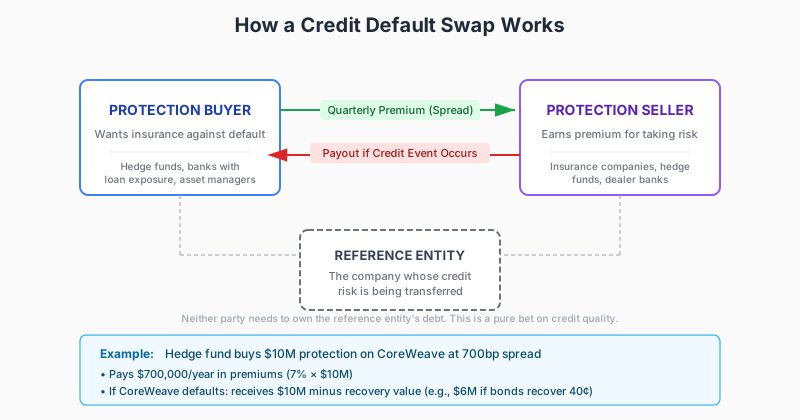
Example: A hedge fund thinks CoreWeave might default. They buy $10 million notional of CDS protection at 700bp. They pay $700,000 per year in premiums (7% of $10M). If CoreWeave defaults, they receive $10 million minus whatever the bonds recover (if bonds recover 40 cents on the dollar, they receive $6 million).
Why institutions love CDS:
- Pure credit exposure with no interest rate risk
- Can assess credit from both directions
- Highly liquid for major names
- Standardized contracts via ISDA
Why CDS isn't accessible to everyone:
- Requires an ISDA Master Agreement (complex legal documentation)
- Minimum position sizes typically $1M+ notional
- Need a prime broker relationship
- Must post margin and meet ongoing collateral requirements
- Effectively limited to banks, hedge funds, and large asset managers
Corporate Bonds
Bonds are the underlying debt itself. When a company issues bonds, investors lend them money in exchange for regular interest payments and return of principal at maturity.
How institutions monitor bonds:
- Buy bonds they think will get repaid (or appreciate in price)
- Monitor bonds they think are overpriced relative to risk
- Analyze the "spread" between different issuers
Challenges for non-institutional monitoring:
- Minimum lot sizes often $100K-$200K face value
- Bond market is OTC (over-the-counter), not exchange-based
- Pricing is opaque; retail gets poor visibility
- Liquidity is poor for non-institutional sizes
You can follow bond ETFs (like HYG or LQD), but those are diversified portfolios. You can't express a view on a single company's credit.
Part 3: The Monitoring Challenge
So you see CoreWeave's CDS spreads at 700bp. You want to understand what this means. What are your options for monitoring?
Option 1: Monitor Stock Price
What you're actually doing: Watching equity value movements.
The problem: Stock prices reflect many things beyond credit risk. A company can have serious credit concerns while its stock rises (maybe they're growing revenue and diluting shareholders to stay alive). Or the stock can crash for reasons unrelated to credit (missed earnings, sector rotation, market selloff).
Example: In 2024-2025, many companies with elevated credit risk saw their stocks rise during AI hype, even as their bond spreads widened. Stock monitoring would have missed the credit signal entirely.
Stock price is equity exposure, not credit exposure. You can be right about the credit and wrong about the equity.
Option 2: Use Options Pricing
What you're actually doing: Monitoring implied volatility and option prices for credit signals.
The problems:
- Still equity exposure, not credit exposure
- Time decay affects pricing in ways unrelated to credit
- Implied volatility is often already high on stressed names, making interpretation difficult
- You're trying to extract credit signals from instruments designed for different purposes
Options can provide some signals if you know what to look for. But they're an imprecise tool for expressing credit views.
Option 3: Bond ETFs
What you're actually doing: Monitoring a diversified basket of bonds.
The problem: You can't isolate single-name risk. If you think CoreWeave specifically is in trouble, monitoring HYG (high yield bond ETF) doesn't help. Your view on CoreWeave is diluted across hundreds of other issuers.
The Fundamental Problem
Here's the core challenge: The market continuously prices credit risk. You can see those prices. But traditional tools for monitoring individual company credit risk have significant limitations.
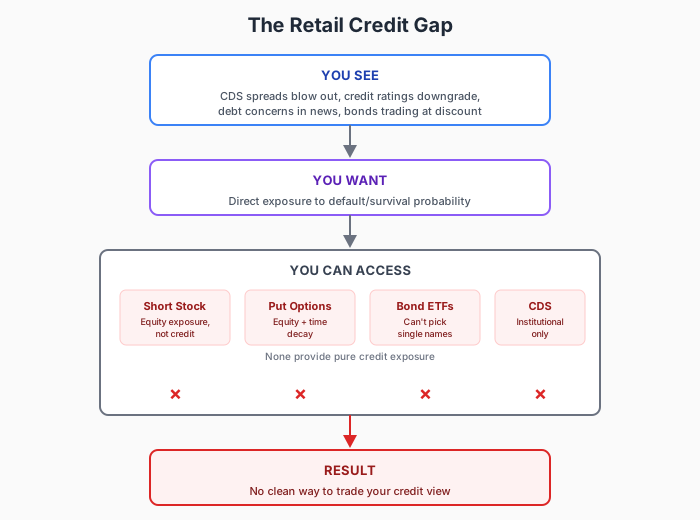
You can watch CDS spreads go from 200bp to 700bp to 1500bp to default. You can see exactly what the market thinks. But without institutional infrastructure, monitoring credit risk effectively has been challenging.
Credit has been one of the last major asset classes where visibility and monitoring tools lag behind what's available for equities.
Until event contracts.
Part 4: Event Contracts - The Credit Monitoring Breakthrough
Event contracts change the monitoring landscape.
What Are Event Contracts?
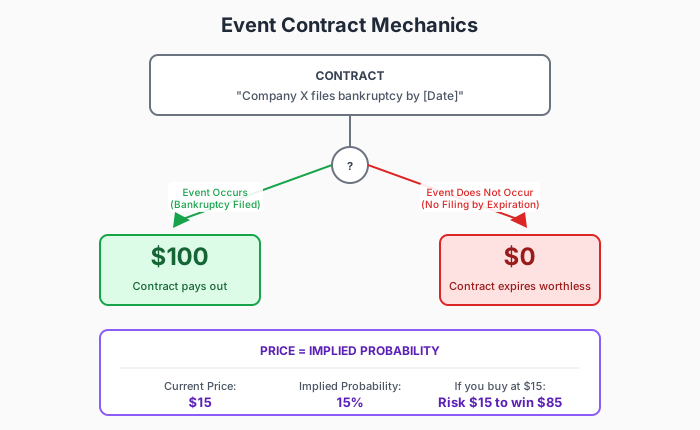
An event contract is a binary contract that settles based on whether a defined event occurs.
Structure:
- Contract pays $100 if the event occurs
- Contract pays $0 if the event doesn't occur
- Price fluctuates between $0 and $100 based on market assessment
The price implies a probability. If "CoreWeave files bankruptcy by December 31, 2026" is priced at $15, the market is implying a 15% probability of that event occurring.
How Pricing Works
Event contract pricing is intuitive once you understand it.
If you buy at $15:
- If bankruptcy occurs: You receive $100, profit = $85 per contract
- If no bankruptcy: You receive $0, loss = $15 per contract
If you sell at $15:
- If bankruptcy occurs: You pay $100, loss = $85 per contract
- If no bankruptcy: You keep $15, profit = $15 per contract
The math:
- Buyer is risking $15 to make $85 (if they think probability > 15%)
- Seller is risking $85 to make $15 (if they think probability < 15%)
The market-clearing price reflects the collective view on probability.
Event Contracts vs. CDS: Key Differences
Event contracts aren't identical to CDS, but for many monitoring purposes, they provide better visibility.
| Feature | CDS | Event Contracts |
|---|---|---|
| Minimum size | $1M+ notional | Often $1 per contract |
| Legal complexity | ISDA Master Agreement | Simple exchange format |
| Settlement | Complex (physical or auction) | Binary cash settlement |
| Exposure type | Protection buyer/seller | Probability assessment |
| Time horizon | Standard tenors (5Y typical) | Specific dates |
| Accessibility | Institutional only | Broadly accessible |
The key trade-off:
CDS offers more flexibility in sizing and more precise economic terms (you're insuring a specific notional amount of debt with specific recovery mechanics).
Event contracts offer simplicity, accessibility, and fixed maximum outcomes. You know exactly what the market is pricing when you observe the price.
For most people monitoring credit, the simplicity and accessibility of event contracts far outweigh the precision advantages of CDS.
Why Binary Contracts Make Sense for Credit
Credit events are inherently binary. A company either defaults or it doesn't. There's no "partial bankruptcy."
Yes, the timing is uncertain. And yes, recovery rates vary after default. But the core event - did the company fail to meet its obligations - is a yes/no question.
This makes credit uniquely suited to event contract structure. Unlike stock prices (which move continuously and can hit any value), credit events are discrete. They either happen or they don't.
Event contracts match the structure of the underlying risk.
Using Event Contracts for Position Sizing
Binary contracts require different position sizing than continuous instruments.
The key principle: You can lose 100% of your position. Size accordingly.
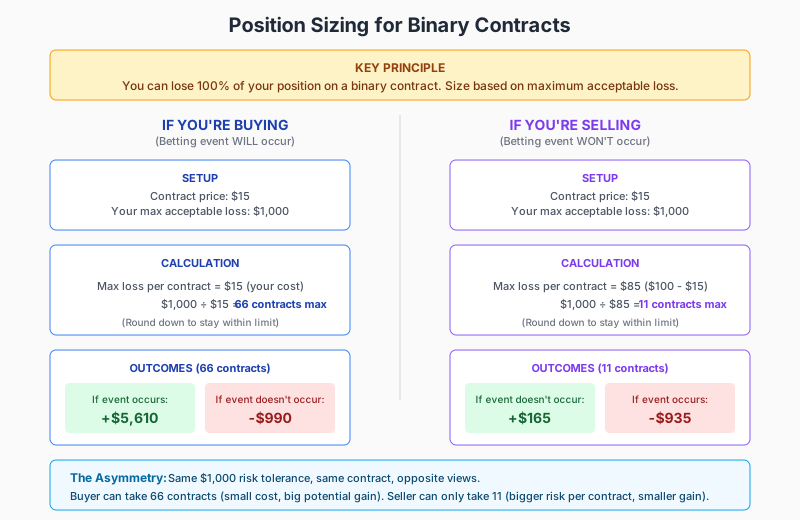
Framework:
- Determine your maximum loss tolerance for this monitoring position
- That's your position size
Example: You're willing to risk $1,000 monitoring CoreWeave's survival. You think the $15 contracts overstate risk (you believe bankruptcy probability is only 5%).
- Sell contracts at $15 each
- Maximum loss = $85 per contract if bankruptcy occurs
- $1,000 risk / $85 max loss = ~11 contracts maximum
If CoreWeave survives, you keep $165 ($15 × 11). If they file bankruptcy, you lose $935 ($85 × 11).
Understanding Implied Probability
The contract price directly implies market probability:
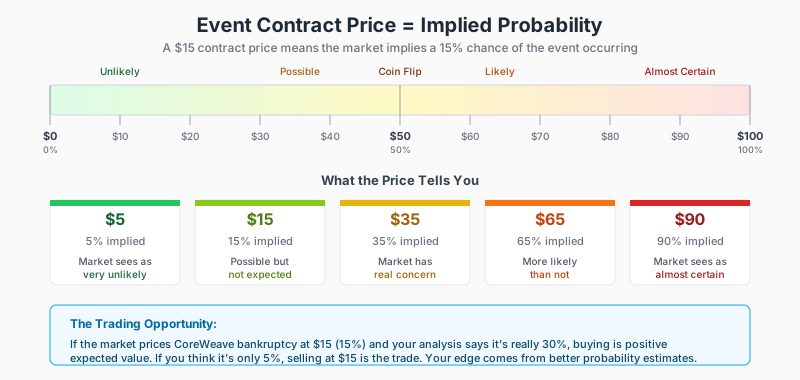
| Price | Implied Probability | What It Suggests |
|---|---|---|
| $5 | 5% | Market sees as unlikely |
| $15 | 15% | Possible but not expected |
| $30 | 30% | Real concern |
| $50 | 50% | Coin flip |
| $70 | 70% | More likely than not |
| $90 | 90% | Almost certain |
To identify opportunities, ask: Does my analysis suggest a probability meaningfully different from what the market implies?
If the market prices CoreWeave bankruptcy at 15% and you think it's really 30%, buying at $15 reflects positive expected value. If you think it's really 5%, selling at $15 reflects that view.
Part 5: Analyzing Credit Situations
Having tools to monitor credit is only valuable if you can identify situations worth analyzing. Here's how to analyze credit situations.
Reading the Signals: When to Pay Attention
Not every company is interesting from a credit perspective. Most investment-grade companies are unlikely to default, and their credit isn't particularly worth deep monitoring.
You're looking for situations where:
1. Credit risk is elevated but uncertain
The market has identified risk (spreads are wide) but there's genuine
disagreement about outcome. Too obvious either way = not interesting.
2. The probability may be mispriced
You believe the market's implied probability is wrong. Maybe spreads
are too wide (company will survive) or too narrow (trouble is
underappreciated).
3. A catalyst exists
Something will resolve the uncertainty: debt maturity, asset sale,
refinancing, earnings report, restructuring negotiation, regulatory
decision.
Sources of Credit Information
Free sources:
- Company SEC filings (10-K, 10-Q, 8-K) for debt structure and covenants
- Rating agency announcements (search "[company name] Moody's" or "[company name] S&P rating")
- Financial news for debt maturity schedules and refinancing news
- Earnings call transcripts for management commentary on liquidity
Professional sources (if you want to go deeper):
- Bloomberg Terminal (expensive but comprehensive)
- S&P Capital IQ
- Moody's Analytics
- Bond pricing services (TRACE data is public but hard to use)
What to look for in filings:
- Total debt and debt breakdown by maturity
- Interest expense vs. operating cash flow
- Covenant compliance (often disclosed in footnotes)
- Liquidity position (cash + available credit facilities)
- Management discussion of refinancing plans
Debt Structure Analysis
Understanding a company's debt structure tells you when and how stress might materialize.
Key questions:
- How much total debt, and what types?
- When does it mature? (The "maturity wall")
- What are the interest costs?
- Are there covenants, and how much cushion exists?
- What's the secured vs. unsecured mix?
Example (hypothetical):
Company X has:
- $500M bonds due 2026 (18 months away)
- $300M revolver (fully drawn)
- $200M term loan due 2027
- Interest expense: $80M/year
- EBITDA: $100M/year
- Cash: $50M
This company has a problem. Interest coverage is barely 1.25x. They have $500M coming due in 18 months with only $50M cash. They'll need to refinance, but will lenders give them new money with such weak coverage?
This is the kind of situation where credit risk becomes worth monitoring.
Case Study 1: CoreWeave, APLD, and IREN - AI Infrastructure Credit Spectrum
CoreWeave, Applied Digital (APLD), and IREN Limited illustrate the full spectrum of AI infrastructure credit risk and show how similar business models can have dramatically different credit profiles. APLD represents a middle ground with acute near-term refinancing risk but stronger underlying fundamentals than CoreWeave.
The setup:
- AI cloud infrastructure company, IPO'd March 2025
- Explosive revenue growth (~200% YoY)
- But: $14 billion in debt to fund data center buildout
- Quarterly interest expense: ~$310 million
- Net loss despite strong EBITDA (interest eats operating profit)
The credit signals:
- CDS spreads widened from ~250bp to 700bp+ in months
- S&P rating: B+ (speculative)
- Moody's rating: Ba3 (speculative)
- Continued debt issuance ($2.6B convertible in December 2025)
- Insider selling during volatility
The bull case (why they survive):
- $55 billion revenue backlog provides visibility
- Blue-chip customers (Microsoft, NVIDIA, OpenAI)
- AI demand remains strong
- Can refinance as rates decline and business matures
The bear case (why they might not):
- $13B+ capex annually requires continuous financing
- Customer concentration risk (what if one major customer cuts back?)
- Interest expense > net income means perpetual cash burn
- Rising rates or risk-off sentiment could close refinancing windows
- Execution risk on data center buildout
How you'd monitor it:
If contracts existed for "CoreWeave files bankruptcy by December 2026":
- At $10 (10% implied), you might buy if you think the risks are underappreciated
- At $40 (40% implied), you might sell if you think the backlog provides safety
- The "right" price depends on your analysis of the probabilities
The AI Infrastructure Credit Spectrum:
| Company | Z-Score | Debt | Interest Coverage | Key Risk | Default Probability |
|---|---|---|---|---|---|
| CoreWeave | 0.66 (distress) | $14B+ | 0.2x | Solvency | 25-35% |
| Applied Digital (APLD) | 0.42-2.59 (distress/grey) | $688M | 0.48x | August 2026 refinancing | 25-35% |
| IREN Limited | 7.84 (safe) | $2B | 18-22x | Execution | 5-10% |
The Lesson: Similar business models don't mean similar credit risk. IREN's conservative leverage creates low credit risk despite high equity volatility. APLD faces acute August 2026 refinancing risk with $375M debt maturity and only $74M cash, creating a near-term crisis despite smaller absolute debt load. CoreWeave's aggressive debt-funded expansion creates pervasive credit stress despite explosive growth. Understanding these distinctions - timing, leverage, liquidity, and customer concentration - is essential for proper risk assessment.
Case Study 2: Spirit Airlines (2024-2025)
Spirit Airlines shows how a credit situation can develop over time.
The arc:
- Low-cost carrier with thin margins
- Failed merger with JetBlue (blocked by regulators)
- Rising fuel costs and labor expenses pressured margins
- Debt maturities approaching with no merger partner
- Filed Chapter 11 bankruptcy in November 2024
The signals in hindsight:
- CDS spreads were elevated for months before filing
- Bond prices were at significant discounts
- Rating agencies downgraded repeatedly
- Company announced "strategic alternatives" (often a warning sign)
The lesson: Credit situations can take months or years to resolve. Spirit's troubles were visible long before bankruptcy. Patient analysts who identified the distress early could have monitored accordingly.
Case Study 3: HCA Healthcare (2006-2022) - A Survival Story!
It's important to remember that elevated credit risk doesn't always mean default.
The arc:
- $33B LBO in November 2006... largest in history at the time, with ~$28B in total debt
- 2008-2009 financial crisis hit hospitals hard (reduced volumes, uncompensated care)
- Downgraded to B+ (deep speculative grade) by S&P, Moody's, and Fitch immediately post-LBO
- Refinanced $14.5B in maturing debt (2009-2014), then completed $3.79B IPO in March 2011
- Outlook upgraded to "positive" in November 2009; steady rating improvements thereafter
- Not only survived—upgraded to investment grade (BBB-) in May 2022
- Current bond spreads in the 70-150 bps range, depending on the specific issue
The lesson: Distressed credits can present opportunities on both sides. Sometimes when a company's credit is trading at distressed levels, that is the ideal opportunity to bet on it not defaulting. In HCA's case, the market was fearful of the wall of maturing debt looming starting in 2009, but the company was able to refinance its way out of trouble and then solidify its balance sheet with cash raised via IPO.
The challenge isn't just to identify distress. It's to evaluate whether distress will become default. If the market underestimates or overestimates the risk of default, that presents opportunities on both sides of the market. Solid credit analysis is how traders differentiate themselves in credit instruments.
Part 6: Monitoring Credit on ZScoreX
ZScoreX provides the platform to convert your credit analysis into systematic monitoring.
Available Contract Types
ZScoreX lists binary event contracts on well-defined corporate credit events:
Bankruptcy contracts:
"[Company] files for US Federal bankruptcy protection (any chapter) by
[Date]"
- Pays $100 if bankruptcy filing occurs
- Pays $0 if no filing by expiration
Each contract has specific terms you need to understand:
- Reference entity: Exactly which company (including subsidiaries?)
- Event definition: Precisely what triggers payout
- Determination source: Who decides if event occurred (bankruptcy filings are public records)
- Expiration: Date by which event must occur
- Settlement: When and how payout happens
Read the specifications carefully. "Bankruptcy filing" is a specific event, and different from all possible CDS "events of default" under ISDA definitions.
Risk Management
Diversify across situations. Don't put all your credit monitoring capital into one company's contracts. Even well-analyzed positions can go wrong.
Respect position limits. ZScoreX may impose maximum positions. These exist for your protection.
Don't average into losers without new information. If you bought at $15 and it moves to $25, that's the market telling you something. Reassess before adding.
Have a thesis for each position. Why do you think the market is wrong? What would change your mind? If the thesis breaks, exit.
Part 7: Advanced Considerations
For analysts who want to go deeper, these concepts add nuance to credit analysis.
Timing: From Credit Stress to Default
One of the hardest aspects of credit analysis is timing. A company can be clearly distressed for years before defaulting, or it can find a lifeline and recover.
Factors that accelerate timeline:
- Imminent debt maturity with no refinancing option
- Covenant violation that accelerates debt
- Liquidity crisis (can't make payroll)
- Loss of key customer or supplier
- Adverse legal judgment requiring large payout
Factors that extend timeline:
- Ample cash runway
- Covenant waivers from lenders
- Asset sales providing liquidity
- Emergency financing (even at bad terms)
- Government support in strategic industries
The implication: When monitoring dated contracts, you need a view on both whether and when default occurs.
Recovery Rates: What Happens Post-Default
When a company defaults, bondholders don't always lose everything. They recover something, typically through bankruptcy proceedings, asset sales, or debt-for-equity swaps.
Typical recovery rates:
- Senior secured debt: 50-70%
- Senior unsecured debt: 30-50%
- Subordinated debt: 10-30%
- Equity: Usually wiped out
Why this matters for event contracts: If you're monitoring bankruptcy contracts, recovery rates don't directly affect your payout (you get $100 regardless of how much bondholders recover). But recovery expectations affect how bondholders behave, and therefore whether they force default or negotiate.
Legal Triggers: What Counts as a "Credit Event"
Contract specifications define exactly what triggers payout. The standard ISDA definitions provide a framework, but event contracts may use simplified triggers.
Common triggers:
- Bankruptcy: Filing for Chapter 7 (liquidation) or Chapter 11 (reorganization)
- Failure to pay: Missing a scheduled interest or principal payment after any grace period
- Restructuring: Certain adverse changes to debt terms (sometimes excluded)
What's NOT typically a trigger:
- Stock price decline (no matter how severe)
- Rating downgrade (unless specifically included)
- Covenant violation (unless it triggers acceleration and missed payment)
- "Technical default" that gets waived
Read your contract specifications carefully.
Correlation: Why Credit Events Cluster
Credit events don't happen uniformly over time. They cluster, especially during recessions and financial crises.
Why clustering happens:
- Economic downturns hit many companies simultaneously
- Credit market stress makes refinancing hard for everyone
- Contagion: one default can trigger others (suppliers, customers)
- Lender psychology: after one loss, lenders tighten credit broadly
The implication: If you hold multiple credit-event positions, they may be correlated. In a normal environment, diversification works. In a crisis, many can go wrong together.
Consider: How exposed is your portfolio to a broad economic downturn?
Conclusion
Credit markets have been institutional-only for decades. The tools existed. The data existed. The monitoring activity existed. But retail access was limited.
Event contracts change that equation.
You can now monitor whether a company survives or defaults - directly, simply, with clear outcomes and no complex legal agreements.
Is it identical to CDS monitoring? No. You give up some flexibility and precision. But you gain accessibility, simplicity, and known maximum outcomes.
For sophisticated analysts who understand credit, who watch CDS spreads and rating actions and debt maturities, who want to translate analysis into systematic monitoring - this is the access that never existed before.
Getting started:
- Build your watchlist of companies with elevated credit risk
- Follow CDS spreads, rating actions, and debt news
- Analyze specific situations using the framework in this guide
- Identify mispricings between your view and market prices
- Size positions appropriately for binary outcomes
Credit markets are now accessible for monitoring. Analyze accordingly.
About ZScoreX
ZScoreX is building institutional-grade infrastructure for event contract monitoring and analysis, starting with corporate credit. We believe credit markets should be accessible to sophisticated analysts regardless of whether they can sign an ISDA Master Agreement.
Learn more at zscorex.com | View our credit analysis | Get in touch with our team